The digital nomad visa in Spain is a residence permit allowing non-EU remote workers and freelancers to live in the country for up to three years while working for foreign companies. To qualify in 2026, applicants must prove a minimum monthly income of €2,850, which equals 200% of the Spanish national minimum wage (SMI) (Source: Exteriores, 2026). The permit allows a maximum of 20% of your total income to come from Spanish clients. Unlike the Non-Lucrative Visa, which forbids all economic activity and requires €2,400 per month, the Spain digital nomad visa explicitly authorizes remote work. Successful applicants receive a one-year visa if applying through a consulate, or a three-year residence card if applying directly from within Spain. This pathway offers a direct route to long-term residency and eventual citizenship for those who maintain their remote employment.

Spain introduced this visa under the Startup Law to attract international talent and offset demographic decline in certain regions. It quickly became the primary immigration route for high-earning professionals, especially after the Spanish government abolished the real estate investment route on 3 April 2025. With the closure of that pathway, remote workers who previously considered property investment now rely entirely on the nomad visa spain offers to secure their residency.
When comparing digital nomad visas across Europe, the Spanish option stands out because it counts the years spent under this permit toward permanent residency and citizenship. However, the legal framework strictly separates employees on a foreign payroll from independent contractors. Employees must obtain a certificate of social security coverage from their home country or register with the Spanish social security system, while freelancers must register as autónomos (self-employed) immediately upon approval.
For non-EU citizens, including Americans and Britons, this visa replaces the legal gray area of working remotely on a 90-day Schengen tourist visa. It provides a legal tax identity (NIE), the ability to sign long-term residential leases, and the right to bring immediate family members under a unified application.
Requirements & Eligibility
To qualify for the Spanish nomad visa, you must demonstrate a stable remote income of at least €2,850 per month, hold an undergraduate degree or three years of professional experience, and have no criminal record for the past five years (Source: Exteriores, 2026). The financial threshold scales based on the national minimum wage (SMI), which is €1,221 per month across 14 payments for 2026. You must also prove your employment or freelance contracts have existed for at least three months, and the company allowing you to work remotely must have been operating for at least one year.
- Primary Applicant Income — 2026 Threshold / Condition: €2,850/month (200% of SMI)
- First Dependent Income — 2026 Threshold / Condition: +€916/month (75% of SMI)
- Additional Dependents — 2026 Threshold / Condition: +€305/month each (25% of SMI)
- Client Base — 2026 Threshold / Condition: Maximum 20% income from Spanish clients
- Company Tenure — 2026 Threshold / Condition: Employer must be active for >1 year
- Contract Tenure — 2026 Threshold / Condition: Must hold current contract for >3 months
- Background Check — 2026 Threshold / Condition: Clean criminal record for the last 5 years
The income requirements for the spain digital nomad visa are strictly enforced using gross income figures. If you apply as an employee, you must submit three months of payslips and a bank statement showing the corresponding deposits. If you apply as a freelancer, you must provide invoices and bank statements proving a consistent income stream that meets the €2,850 threshold.
Dependents scale the financial requirement predictably. A married couple applying together needs €3,766 per month (€2,850 + €916). A family of four requires €4,376 per month. These figures are tied directly to the SMI; because the Spanish government set the 2026 SMI at €1,221 per month (paid in 14 installments, totaling €17,094 annually), the 200% multiplier for the primary applicant results in the €2,850 monthly requirement.
Beyond finances, the educational and professional requirements act as a filter. You must submit a university degree from a recognized institution or prove three years of continuous, relevant work experience in your field. The Spanish authorities require this to ensure applicants are highly qualified professionals. Furthermore, the company you work for must issue a formal letter stating that your specific role can be performed remotely from Spain.
Step-by-Step Process
Applying for a digital nomad visa for Spain requires gathering sworn translations, securing an apostille for public documents, and submitting your dossier either at a consulate or directly in Spain.
- Choose your application location: You can apply at the Spanish consulate in your home country for a one-year visa, or enter Spain legally as a tourist and apply directly through the UGE (Unidad de Grandes Empresas) for a three-year residence permit. The UGE route is highly preferred because it grants a longer initial residency period.
- Gather corporate documentation: Obtain a letter from your employer explicitly authorizing remote work from Spain. The letter must state your salary, your position, and confirm that the company has existed for more than one year. Freelancers must provide commercial contracts proving a long-term relationship with foreign clients.
- Apostille and translate documents: Secure a Hague Apostille for your national background check (e.g., an FBI background check for US citizens) and your university degree or marriage certificate. Hire a sworn Spanish translator (traductor jurado) registered with the Spanish government to translate these documents (Source: Balcellsgroup, 2026).
- Obtain private health insurance: Purchase a comprehensive Spanish health insurance policy. The policy must offer full coverage with zero copayments and no waiting periods.
- Submit the application: File the paperwork and pay the administrative fee. If applying through the UGE, you or your legal representative must submit the dossier online using a Spanish digital certificate. The UGE legally has 20 working days to process applications submitted from within Spain.
- Register your fingerprints (TIE): Once approved in Spain, book a cita previa (prior appointment) at the local police station. Submit your fingerprints, provide passport photos, and collect your physical Foreigner Identity Card (TIE) roughly 30 days later.
The bureaucratic reality of the spain digital nomad visa requirements demands extreme attention to detail. Background checks are only valid for three to six months from the date of issuance, depending on the consulate. Because securing an apostille from the US Department of State or the UK Foreign Office can take several weeks, timing the document gathering phase is critical. If a document expires before you submit your application, the Spanish authorities will reject the dossier.
When applying through the UGE from within Spain, the "administrative silence" rule applies. If the UGE fails to respond within 20 working days, the application is technically considered approved by positive silence. However, in practice, the UGE frequently pauses the clock by issuing a requerimiento—a formal request for additional or corrected documents. You typically have 10 working days to provide the missing paperwork before the application is denied.
Costs & Budget
The total cost to apply for the Spain digital nomad visa ranges from €500 to €2,000, depending on whether you hire an immigration lawyer or process the paperwork independently. The government application fees are relatively low, but the mandatory sworn translations, apostilles, and upfront health insurance premiums add significant upfront expenses (Source: Migrun, 2026).
- Government Application Fee — Estimated Cost: €73.26 (Consulate) or €89.96 (UGE)
- TIE Card Issuance Fee — Estimated Cost: €16.08
- Sworn Translations — Estimated Cost: €100 - €300
- Apostille Services — Estimated Cost: €20 - €50 per document
- Private Health Insurance (Annual) — Estimated Cost: €600 - €1,200
- Legal / Agency Fees (Optional) — Estimated Cost: €800 - €1,500
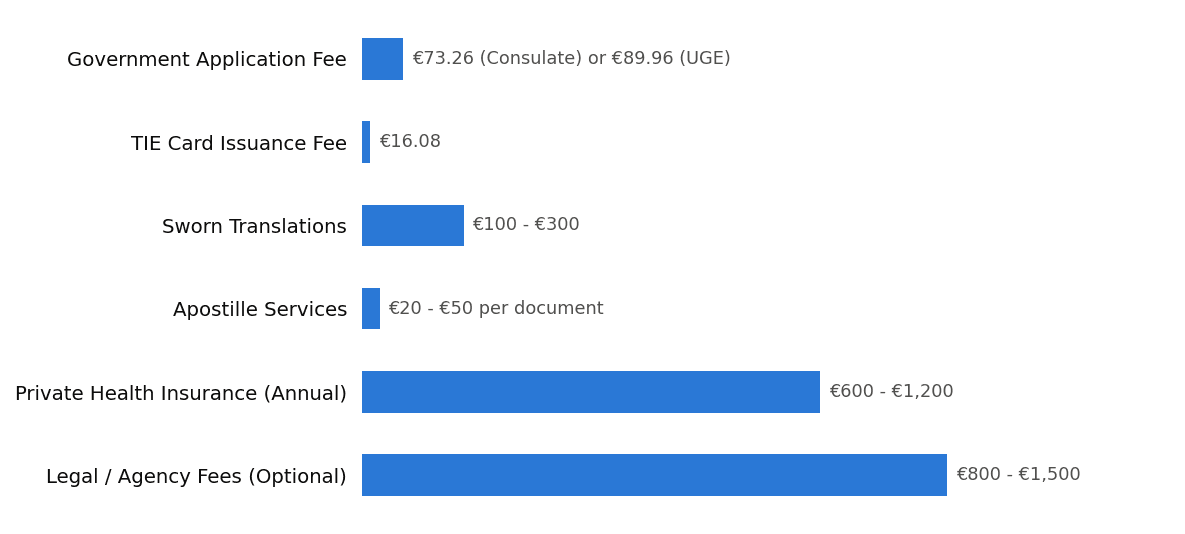
While the baseline government fees are under €100, the hidden costs of the application process accumulate quickly. Sworn translators charge per word or per page, and a lengthy FBI background check with multiple apostille pages can cost over €100 to translate alone.
Legal fees represent the largest variable cost. Many applicants hire a gestor (administrative agent) or an immigration lawyer to review their documents and submit the application through the UGE portal using a professional digital certificate. This service typically costs between €800 and €1,500. While not legally required, professional assistance drastically reduces the risk of a rejection due to formatting errors or missing apostilles.
You must also budget for the physical relocation. The Spanish nomad visa requires you to secure housing, and landlords in major Spanish cities frequently demand substantial upfront payments from foreigners who lack a local employment contract.
Cost of Living / Money Reality
The cost of living in Spain varies drastically between major hubs like Madrid or Barcelona and smaller coastal or inland cities. A single digital nomad in Spain needs a comfortable budget of €2,000 to €3,000 per month to cover rent, groceries, utilities, and leisure (Source: Numbeo, 2026). While the visa requires a minimum income of €2,850 per month, this figure provides a highly comfortable lifestyle in cities like Valencia or Alicante, but requires tighter budgeting in central Barcelona, where one-bedroom apartments routinely exceed €1,200 per month (Source: Idealista, 2026). Groceries cost roughly €300 to €400 per month, and utility bills for electricity, water, and high-speed internet add another €150. Because inflation has impacted housing markets heavily, remote workers must balance the appeal of major metropolitan areas against the lower costs and higher purchasing power found in regions like Andalusia or Galicia.
- 1-Bedroom Apartment (City Center) — Madrid / Barcelona: €1,200 - €1,600; Valencia / Alicante: €800 - €1,100
- Utilities (Electricity, Water, Internet) — Madrid / Barcelona: €150 - €200; Valencia / Alicante: €120 - €160
- Groceries (Monthly) — Madrid / Barcelona: €300 - €400; Valencia / Alicante: €250 - €350
- Public Transport Pass — Madrid / Barcelona: €40 - €50; Valencia / Alicante: €30 - €40
- Dining Out (Mid-range, 2 people) — Madrid / Barcelona: €50 - €70; Valencia / Alicante: €40 - €60

Housing is the primary financial variable for any digital nomad spain hosts. In Madrid and Barcelona, the influx of foreign remote workers has driven up rental prices in central neighborhoods like Eixample or Malasaña. A standard one-bedroom apartment in these areas easily consumes half of the €2,850 minimum income requirement. Conversely, cities like Málaga, Seville, and Las Palmas de Gran Canaria offer a lower cost of living while maintaining excellent infrastructure and large expat communities.
Everyday expenses remain highly affordable compared to the United States or Northern Europe. A monthly public transport pass in Madrid costs under €50, and the high-speed rail network (AVE) makes domestic travel efficient. Groceries at local supermarket chains like Mercadona or Consum are inexpensive, with fresh local produce, olive oil, and wine priced well below the European average.
However, remote workers must account for the exchange rate. Because the income requirements are set in Euros, Americans earning in USD face currency fluctuation risks. If the Dollar weakens against the Euro, your effective purchasing power drops, and you must ensure your USD salary continues to meet the €2,850 threshold at the time of your visa renewal.
Taxes for Americans
American remote workers become Spanish tax residents if they spend more than 183 days in the country during a calendar year (Source: Agencia Tributaria, 2026). Once you are a tax resident, Spain taxes your worldwide income. The Beckham regime offers a flat 24% tax rate on Spanish employment income up to €600,000 per year for six years, but this is strictly limited to employees on local payrolls; freelancers and autonomous workers are excluded. US citizens must also continue filing federal tax returns with the IRS. To avoid double taxation, Americans can utilize the Foreign Earned Income Exclusion (FEIE) or the Foreign Tax Credit (FTC). Furthermore, Spain enforces a wealth tax on worldwide assets, though regions like Madrid and Andalusia offer a nearly 100% regional rebate on this tax.
The tax implications of the digital nomad visa for spain are complex and heavily dependent on your employment status. If you are a W-2 employee for a US company, you can apply for the Beckham Law (Régimen Especial para Trabajadores Desplazados) within six months of arriving in Spain. This regime allows you to be treated as a non-resident for tax purposes. You pay a flat 24% on income earned in Spain, and your foreign-sourced passive income (like US capital gains or dividends) is not taxed by Spain.
If you are a 1099 independent contractor or a freelancer, you do not qualify for the Beckham Law. You must register as an autónomo in Spain and pay progressive income tax (IRPF) on your worldwide income. The IRPF brackets scale up to 47% depending on the autonomous community you live in. Additionally, freelancers must pay monthly social security contributions, which start at a reduced rate of roughly €80 for the first year but scale up based on real net income in subsequent years.
The wealth tax (Impuesto sobre el Patrimonio) is another critical consideration. Spain taxes the worldwide assets of its tax residents, including real estate, stock portfolios, and bank accounts. The threshold for the wealth tax is generally €700,000 per individual, plus €300,000 for a primary residence. However, taxation is decentralized in Spain. Madrid and Andalusia have implemented a 100% rebate on the wealth tax, effectively nullifying it for residents of those regions. In contrast, regions like Catalonia and the Valencian Community enforce the wealth tax strictly.
Because the US and Spain have a bilateral tax treaty, you will not pay tax twice on the same income. You will pay the higher of the two tax bills. Since Spanish tax rates are generally higher than US federal rates, Americans usually owe taxes to Spain and use the Foreign Tax Credit to offset their US IRS obligations to zero.
Healthcare & Insurance
Applicants for the Spanish nomad visa must purchase comprehensive private health insurance before submitting their dossier (Source: Heymondo, 2026). The policy must offer coverage equal to the Spanish public healthcare system, meaning it must have zero copayments, no waiting periods (sin carencias), and full coverage for hospitalization and repatriation. Standard travel insurance is not accepted by the immigration authorities. Once you are legally residing and paying social security in Spain—if your employment setup requires it—you can eventually access the public healthcare system. Until then, maintaining a compliant private policy is a strict requirement for both the initial visa and any subsequent renewals. Policies typically cost between €50 and €100 per month depending on your age and pre-existing conditions, and you must pay the entire first year of premiums upfront to prove coverage.
The Spanish healthcare system is consistently ranked among the best in the world, but the digital nomad visa requires you to rely entirely on the private sector during your initial transition. Providers like Sanitas, Adeslas, and DKV offer specific policies designed for foreign residents that meet the "sin copagos" (no copayments) and "sin carencias" (no waiting periods) requirements.
When you purchase the policy, the insurance company will issue a specific certificate for immigration purposes. You must include this certificate in your application dossier. If your policy includes copayments—even as low as €1 per visit—the UGE or the consulate will reject your application.
If you register as an autónomo and begin paying monthly social security contributions, you gain the right to use the Spanish public healthcare system (Seguridad Social). At that point, you can choose to drop your private insurance at the time of your visa renewal, though many expats maintain private coverage for faster access to specialists and English-speaking doctors.
Honest Downsides
The digital nomad visa for Spain has distinct drawbacks, primarily concerning bureaucratic delays and heavy tax burdens for self-employed individuals. The application process is notorious for shifting requirements between different consulates, and the UGE portal frequently experiences technical outages. Furthermore, freelancers (autónomos) face high monthly social security contributions, which start around €80 for the first year but scale up based on real income in subsequent years (Source: Agencia Tributaria, 2026). Finding long-term housing is also difficult; landlords often demand Spanish payroll documents (nóminas) and are hesitant to rent to foreigners relying on foreign income. This forces many nomads to pay six to twelve months of rent upfront to secure an apartment, draining their initial savings before they even settle into the country.
The housing market presents the most immediate practical challenge. Spain's urban tenancy laws (Ley de Arrendamientos Urbanos) heavily protect tenants, making it extremely difficult to evict non-paying renters. As a result, landlords and rental agencies require extensive financial guarantees. Because a foreign employment contract holds no legal weight in a Spanish court, landlords view digital nomads as high-risk tenants. You will likely need to use a relocation agency or offer massive upfront cash payments to secure a standard one-year lease.
Bureaucracy is another persistent friction point. The Spanish administrative system relies heavily on the cita previa (prior appointment) system, which is severely backlogged. Securing an appointment to register your address at the town hall (empadronamiento) or to submit your fingerprints for your TIE card can take weeks or months of daily refreshing on government websites.
Finally, the tax reality for independent contractors is harsh. Unlike the Croatia digital nomad visa, which offers a zero-tax environment for remote workers, Spain taxes you heavily if you do not qualify for the Beckham Law. Freelancers must navigate quarterly VAT (IVA) filings, progressive income tax brackets, and scaling social security fees that can consume a significant portion of their gross income.
Frequently Asked Questions
How hard is it to get a digital nomad visa in Spain?
Getting a digital nomad visa in Spain is moderately difficult due to strict document requirements. You must gather apostilled background checks, sworn translations, and specific employer letters. While the financial threshold is clear, bureaucratic inconsistencies between consulates make the process tedious.
Who is eligible for Spanish digital nomad visa?
Non-EU citizens who work remotely for foreign companies or have freelance clients outside of Spain are eligible. You need a monthly income of at least €2,850, a clean criminal record, and either a university degree or three years of relevant professional experience.
How much money do I need for a digital nomad visa in Spain?
You need to prove a stable monthly income of €2,850 for a single applicant in 2026. If you bring dependents, you need an additional €916 per month for the first dependent and €305 for each subsequent family member.
How much money do you need in your bank to move to Spain?
While the digital nomad visa relies on monthly income rather than savings, you should have at least €5,000 to €10,000 in your bank account. This covers upfront relocation costs, private health insurance premiums, and potential demands for upfront rent payments.


