
Brazil
Learn More About Moving to Brazil
Eager to live within the pulse of Latin America? Find support in your journey through Relocate. Dig-deeper to read topic specific articles about Brazil and connect with qualified, bilingual Brazilian Advisors who can help you navigate your specific immigration needs.
General Information About Brazil
Diverse and colorful culture combined with complex landscapes, Brazil is an ever-popular destination for travel and relocation. Sprawled across 8.5 million km² and boasting a population of 213 million occupants, it is the world’s 5th largest country in size as well as population. Brazil is defined as the territorial head honcho of South America, enclosing almost half of the land within its borders. Like the continental United States, Brazil crosses four time zones. Home to the world’s most extensive virgin rainforest and over 7,000 miles of coastline, from cityscapes to sparkling Iguaçu Falls, colonial towns to Sugarloaf Mountain, the Amazon to Bahia, there is no shortage of sights to see.
Brazil lies in the Southern Hemisphere, so seasons are opposite to those in the Northern Hemisphere and summer months range from December to March while winter extends from June to August. Climates vary based on area, from tropical to subtropical and a pocket of arid with a minimum average temperature of 21°C and the average maximum of 27°C. Rio de Janeiro in the southeast experiences periods of heavy rainfall during winter. Overall, Brazil offers year-round sunshine, though visitors tend to prefer the winter season and simply plan around the predictable afternoon rainfall.
The immigration system for Brazil is relatively transparent and navigable if you know what you're looking for. Brazilian authorities are increasingly known to follow the law and public offices are generally welcoming to non-locals, dutifully prospective residents with their processes and questions. Services paid for are services rendered and it is useful to do adequate research and solicit guidance for your immigration process as needed.
Rio de Janeiro and São Paulo are top destinations for relocation, business, investment and retirement. Rich in both human and natural resources, with an enviable cultural heritage - Brazil pulsates with architecture, art, literature and music. A former Portuguese colony, Brazil declared its independence in 1822 and has forged forward since, paying homage to Europe yet maintaining its own distinct identity.
Brazilian Cities
Below we have compiled a quick overview of some of Brazil’s most popular cities for relocation.
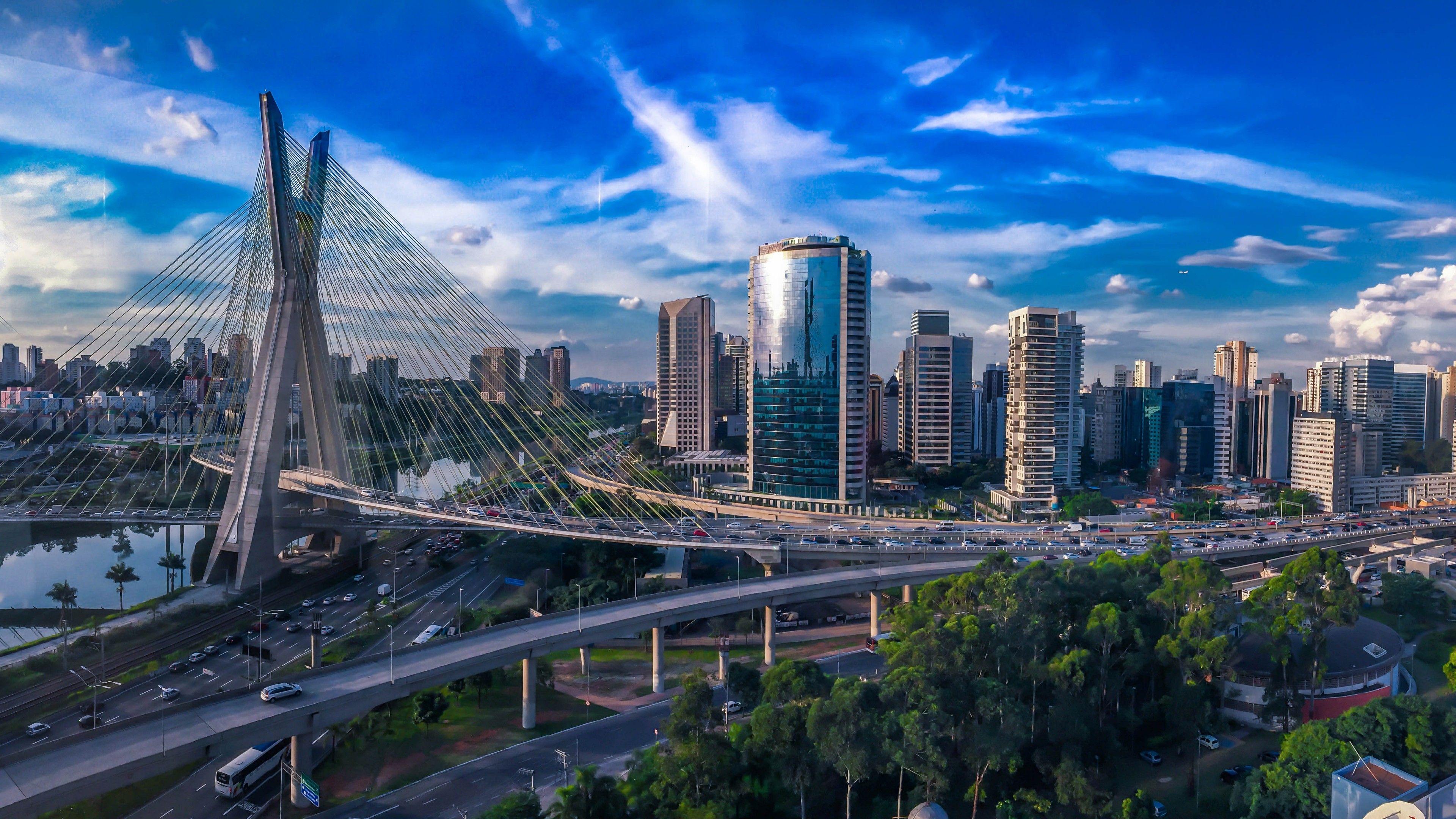
São Paulo was founded in 1554 as a Portuguese mission, and the city is now home to almost 20 million people, referred to as paulistas. The paulista lifestyle is characterized by the highs and lows of living in a massive metropolis: a high quality of life, excellent shopping, dining and entertainment at your fingertips, plus advancing business opportunities. Whereas, drawbacks include pollution, heavy traffic, high crime rates, and income inequality resulting in extreme poverty. Some areas are more desirable than others in terms of safety, so do your research and consult locals on how to best maintain personal safety and security in the city.
Futebol (soccer) is the most popular sport in São Paulo; consequently, the city hosts numerous amateur clubs and three first-league soccer teams – Corinthians, Palmeiras, and São Paulo FC. Churrasco is an ever-popular Brazilian grill for family and friends, and most houses in São Paulo are equipped with a churrasqueira, or barbeque area. Many São Paulo families spend weekends at apartments on the beach or in the nearby mountains. On evenings prior to long weekends endless lines of cars stream out of the city towards leisure destinations.
Rio de Janeiro is Brazil’s second largest city, nicknamed the cidade maravilhosa (the marvelous city), it merits the compliment. Tucked between the sparkling South Atlantic and wreathed by forested mountains, Rio is picturesque. Thanks to its geography, parts of Rio are among the most densely populated places on the planet - with almost 7 million inhabitants, real estate took a turn for the vertical. The Tijuca Forest, the world’s largest urban forest, covers the mountains behind the city. On the Corcovado peak (named for the hunchback it resembles) stands the city’s most famous landmark – Cristo Redentor (Christ the Redeemer), a 30-meter statue of Christ embracing the urban commotion below his feet. From Corcovado, you’ll set eyes on a perfect view of Rio’s other famous mountain – Pão de Açúcar (Sugar Loaf).
Rio’s most desirable bairros (neighborhoods) comprise the zona sul, but some, like Copacabana, are not what they used to be. Many expatriates choose to live in apartments in the zona sul, in the bairros of Leblon, Ipanema, and Lagoa.
Porto Alegre is the capital city of the Brazilian state of Rio Grande do Sul, which borders Argentina. It’s proud of its green spaces, covered by more than 1.5 million trees – one for each inhabitant! While it is Brazilian at heart, Porto Alegre’s cultural blend is uniquely European thanks to migration patterns of the nineteenth and twentieth centuries. Traces of German, Italian, Spanish, and Polish language and traditions are visible everywhere.
Music lovers and party people will quickly feel at home in Porto Alegre's lively nightlife. When it comes to entertainment there is something for everyone: jazz sessions, Cidade Baixa's discos and bars, plus, the Centro Cultural Usina do Gasômetro, a century-old power station converted into a cultural center hosting a cinema, theater, art galleries, cafe, and a bookshop. Porto Alegre's economy is diverse and includes rural and urban interests, such as: agricultural value-adds to manufacturing textiles, metallurgic goods, communication equipment, and pharmaceuticals. Steel mills, petrochemical and oil complexes, educational centers, and financial institutions round out the mix.


Brazilian street-art has been attracting attention for decades
Moving to Brazil Overview
Brazil is part of the BRIC nations – with Russia, India, and China. These wealthy, emerging economies are rising and may soon become new global powers. Brazil’s large population and natural resources, including gold, uranium, petroleum, and hydropower, make it a clear frontrunner for global success. It’s still on its way, but the Brazilian drive to become a superpower is important if you are looking to start a business or move your company to Brazil.
Shipping is the most efficient, least expensive way to safely bring belongings to Brazil. Many excellent shipping companies can help you manage this aspect of your move. The World Bank calculates that air freight is 12-16 times more expensive than sea cargo, making it a less attractive option.
Brazilian weather exceeds expectations. Brasília, the capital and administrative center of Brazil, basks in 2,400 hours (about 3 and a half months) of sunshine every year. We hope you like feeling warm and tanned, because you are about to get a lot more sunshine. Even better, soak it up on one of Brazil’s 2,095 stunning beaches.
Coffee is life. Brazilians and their economy run on coffee, exporting a quarter of the world’s coffee supply, or 5.7 billion pounds of coffee annually. Brazilians are deep coffee devotees - never refuse a cafezinho (small coffee) when a guest in someone’s home.
Compared to prices in other markets, the affordability of Brazilian real estate may come as a surprise. Your budget will take you farther than it would in Europe or North America. All markets, even desirable housing markets with top addresses in Sao Paolo, Rio de Janeiro are open to foreign purchases and investments. You do not necessarily need a broker, but you should be informed about what you want and your budget. Many foreign nationals retain legal counsel to assist them with real estate purchases.
Prior to purchasing a property, you must obtain a CPF (equivalent to a U.S. social security number) and be in good standing. You also need a representative on the ground who is also in good standing with the Receita Federal, or Brazilian IRS, and the "letter of sale" must be signed prior to starting the process.
Securing employment before you move to Brazil is key. You must obtain a residence permit and work visa to lawfully engage in paid employment in Brazil. The prospective employer must apply for a work visa on your behalf. They begin this process by submitting copies of your employment contract, CV, required work documents, and a certified copy of your passport to the Brazilian Ministry for Labour and Employment. When this application is approved in Brazil, you must apply for a work visa through your local Brazilian consulate. A temporary work visa expires after two years. The work visa can be renewed for an additional two years, after which your company must apply for a permanent visa on your behalf if you intend to remain in Brazil on a long-term basis. When you are on a temporary work visa, you cannot change employers without permission.
You must collect several documents from the federal police within 30 days of your arrival in Brazil, including an ID card and a taxpayer ID. The taxpayer ID is required to open a bank account. Apply for your Brazilian visa as early as possible, processing time can two to three months or longer.
Brazil is an economy in transition. Per IMF 2019 data, Brazil ranks as the ninth-largest economy in the world with a GDP of $1.839 trillion. Brazil is still in recovery from a devastating recession fueled by political uncertainty, high unemployment rates, and inflation.
As with many emerging markets, investing in Brazil demands a tradeoff between risk and reward. Political instability and commodity dependence make it a riskier prospect than other more developed markets. International investors know Brazil best for its rich natural resources. Brazil's top export is soybeans which account for close to 14% of all exports, totaling $33.2 billion as of September 2020. In addition to extensive offshore oil fields, after Australia, Brazil is the second-largest producer of iron ore in the world, exporting $20.5 billion of iron ore. Brazil also produces more ethanol than Asia and Europe combined.
China, the U.S., and Argentina are Brazil’s top three export destinations. China leads the way at $64.3 billion in Brazil exports. The U.S. and Argentina are distant contenders at $29.3 billion and $15.0 billion, respectively. Brazil’s economy is dependent on its exports; therefore, it relies heavily on external financing.
Before you invest in Brazilian companies, research the political climate and the outlook of the export industry.
One of Brazil’s strongest attributes is its universal healthcare. Anyone who is legally in Brazil is guaranteed access to medical services. The system is administered by cities and states, and is funded by local, state and federal taxes. Thus, public (government-funded) hospitals and clinical are free and offer a full range of high-quality services.
Private healthcare facilities are also available at charge. Foreigners typically purchase private health insurance and opt for private facilities due to the especially long wait times in the public sector. Consider purchasing private health insurance if you anticipate health needs, prefer not to wait for service, or require English-speaking medical professionals.
Public education is guaranteed at no cost for everyone in Brazil, including expatriates.
Starting at age six, children attend Ensino Fundamental (Elementary and middle school) for nine years. Students then continue on to Ensino Médio (high school) for an additional three years. Verified Portuguese language proficiency and qualifying adaptação (entrance examination) are prerequisites to attend public school.
São Paulo has many private international schools catering to expats and affluent locals. While most international schools follow the U.S. curriculum, other curriculum options include: German-Brazilian schools (Colégio Humboldt and Colégio Visconde de Porto Seguro), the French Liceu Pasteur, the Swiss School of São Paulo, and the British St. Paul’s School. These international schools offer both the national curriculum of their respective countries along with the opportunity to complete the International Baccalaureate (IB) and/or a Brazilian high school diploma. International education carries significant fees. Depending on the school and grade level, plan to spend around 60,000 BRL annually on tuition, excluding registration fees.
In Brazil all income tax is federal, no provisions exist for local, state, or provincial income taxes.
Brazilian taxes are relatively simple, and locals generally file their annual tax returns on their own. Tax brackets are dependent on income. After determining if you are required to pay taxes, which is likely the case if you are moving for long term or work purposes, then you must correctly identify your tax bracket. Tax brackets range between 7.5% and 27.5% and are subject to change. Taxes must be prepared and filed by April 30 after the end of the tax year on December 31.
Legal residents of Brazil are taxed on their worldwide income. Non-residents are taxed only at source on their Brazilian-sourced income. The source of income is governed by the place where the income payer is located, regardless of where the work is performed. For reference, non-resident taxpayers are taxed only on Brazilian-earned income at a flat rate of 25% - no deductions allowed. Rental income received from Brazilian property is taxed at 15%. Income received abroad by non-residents is tax-exempt.
Sales tax in Brazil is 17% - less than EU countries, but more than the average U.S. sales tax rate.
Read more about Paying Taxes in Brazil
Pristine beaches, lush rain forests hosting a wide array of fauna and flora, coupled with a laid-back and fun-loving culture dancing under skies full of sun. It’s no wonder Brazil is a popular retirement destination! Enjoy the freshest cafezinho in a country where the cost of living is relatively low for the high quality of life.
Drawbacks exist, however. Proficiency in English is uncommon, particularly far from the larger main cities. Violent crime is a notorious problem in large cities. You will likely want to visit Brazil several times before you make a final decision.
Applicants for a Brazilian retiree visa must be over 60 years of age and have a pension of at least $2,000 USD per month. Apply for the visa one to two months before you travel at the Brazilian consulate with jurisdiction over your legal residence. Be prepared to provide relevant vital records with accompanying apostilles and sworn translations.
Although Income taxes on global income are progressively taxed up to 27.5% for legal residents, retiree pensions are often taxed differently. Working closely with a qualified financial professional will ensure that pension earnings do not face double taxation.
Read more about Retiring in Brazil
Featured Advisors
Connect with qualified Experts in Brazil
Find the perfect Advisor based on your relocation needs.